

May 11, 2026
Light at Night: The Most Overlooked Mental Health Variable in Design
Most lighting strategies are calibrated for daytime performance. The more critical condition begins after sunset.
Artificial light at night directly interferes with the circadian system by delaying melatonin release. According to the World Health Organization and multiple studies published by Harvard Medical School, prolonged exposure to light at night is associated with increased risks of depression, anxiety, and sleep disorders.
“Light is the most powerful synchronizer of the human circadian clock.” — George Brainard (Jefferson's Light Research Program)
Despite this, design rarely addresses nighttime conditions as a primary parameter. Exterior lighting is driven by visibility and identity. Interior lighting often remains static, regardless of time.

The result is environments that never fully transition into rest.
A mental health-informed approach requires a shift in priorities. Not less light. Less unnecessary light.
Façades should reduce output after peak hours, allowing buildings to recede rather than dominate. Interior environments should transition toward lower intensities and warmer spectral distributions, ideally below 3000K, aligning with the body’s natural evening response. Shielding and directional control become critical to minimize direct retinal exposure.
“Even low levels of light can suppress melatonin if exposure is sustained.” — Charles Czeisler, Harvard Medical School

Duration becomes as important as intensity.
A moderate light level sustained over hours can be more disruptive than a brief, brighter exposure.
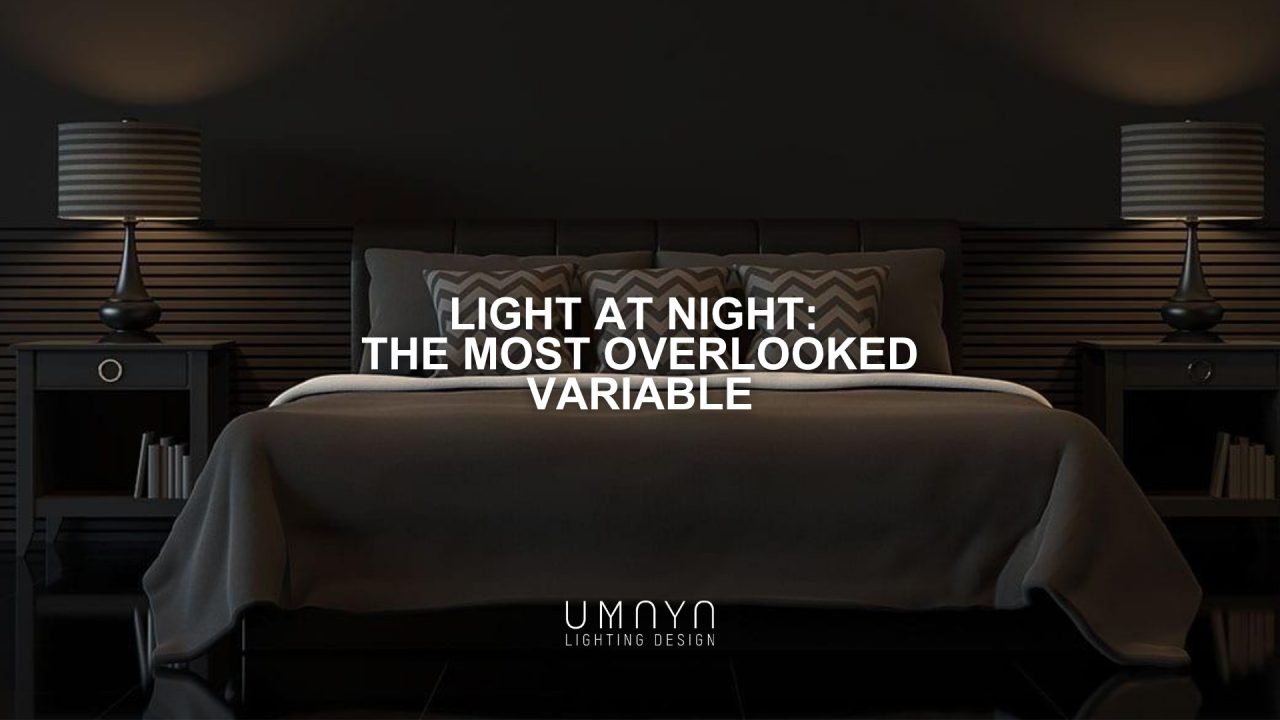
Bedrooms and resting areas must allow full darkness. Not dimness. Darkness.
This is where design moves beyond visual comfort and into biological impact.
Designing for night is not an aesthetic exercise. It is a physiological requirement.